MC-PowerFlow X
The concrete admixture for reliable workability with sustainable cements, recycled materials and challenging aggregates.
Clinker reduction – cements with calcined clays
Cement is a hydraulic binder primarily used in the construction industry. It is produced by firing a raw mix consisting of limestone and clay in a rotary kiln, resulting in clinker, which is subsequently ground finely and blended with additives. The Romans were already using hydraulic binders in ancient times. Industrial cement production only began in the 19th century with the invention of Portland cement and is now facing new, sustainable developments.
The challenge of clinker reduction
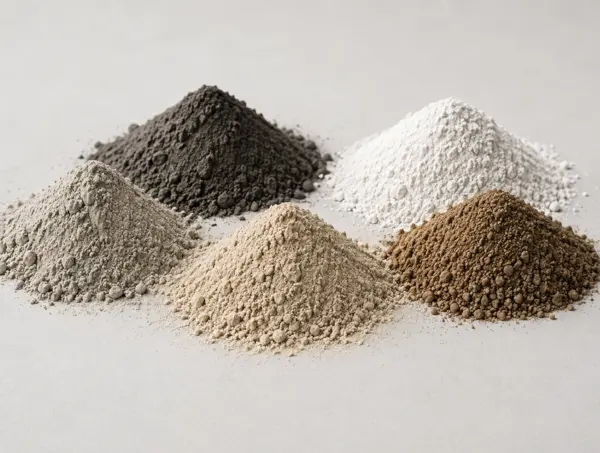
Clinker reduction means CO₂ reduction
The strength of concrete is one of the most important properties, and the cement binder is primarily responsible for achieving it. Cement consists mainly of hydraulic clinker, which reacts in contact with water. A chemical reaction that occurs during the burning of clinker releases CO₂, which contributes significantly to overall emissions. In order to reduce the proportion of clinker in cement – and thus its carbon footprint – the cement industry is increasingly using various additives.
Calcined clays
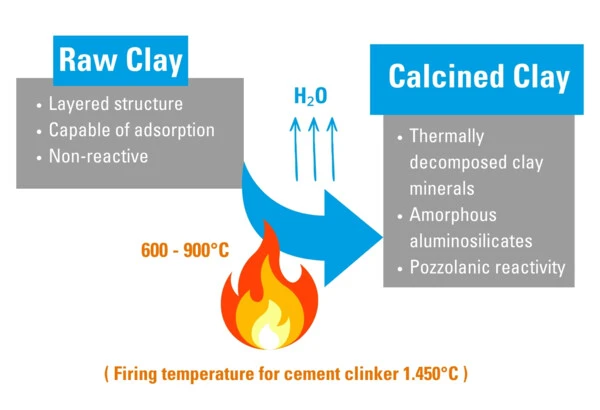
A promising new approach to reducing the carbon footprint of cement production is the use of calcined clays. This makes it possible to use clay deposits that have previously seen little use. In their natural state, these clays do not have any reactive properties when mixed with cement. When heated and dehydrated, they develop pozzolanic reactivity and can therefore reduce the clinker content of cement.
How does MC-PowerFlow X Work with Calcined Clays?
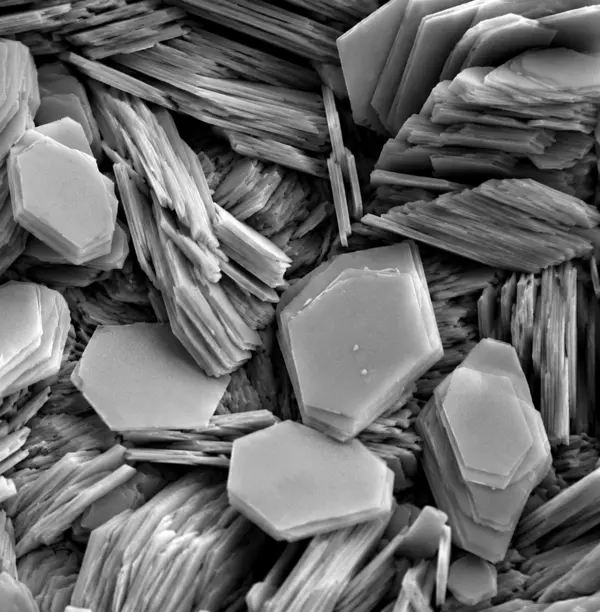
Binding of clay particles with MC-PowerFlow X
One disadvantage of using calcined clays is that conventional admixtures initially bind to the clay particles. As a result, they can no longer fully develop their effect in terms of concrete consistency and slump retention. MC-PowerFlow X compensates for this reduced effectiveness due to its completely new chemical composition. When added to the concrete first, it binds the clay particles, allowing subsequent admixtures to regain their full effectiveness. This makes it possible to produce concrete as usual – while significantly reducing its CO₂ footprint.
Application Example
When using cements containing calcined clay, it has been observed that the flow properties of the concrete or mortar are negatively affected. The higher the proportion of clay replacing clinker, the more pronounced this effect becomes. In the following example, the superplasticizer MC-PowerFlow 3100 is used. Across the formulations, the clinker content is gradually reduced from 50% (LC3-50) to 20% (LC3-20), while flow decreases from 235 mm to 100 mm. With an additional dosage of MC-PowerFlow X, a flow spread of 250 mm can even be achieved with LC3-20.
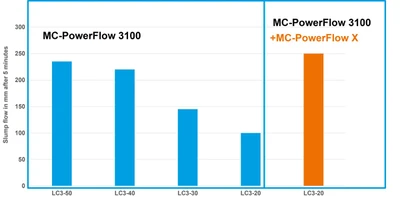
Development of the concrete’s flow properties
Want to learn more about the effect of MC-PowerFlow X with calcined clay?
Simply fill out our contact form and we will get back to you shortly to arrange a personal consultation.